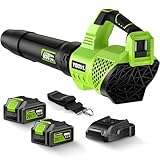
Ever stared at a pile of fallen leaves, wondering how that magical machine you wield can transform chaos into neat piles? You’re not alone! The humble leaf blower, a staple of autumn yard work, is surprisingly sophisticated in its design.
But have you ever stopped to think about the engineering behind that powerful gust of air? It’s more than just a fan in a box; it’s a clever application of physics and mechanics designed to make your life easier. Let’s demystify this essential tool and explore exactly how does a leaf blower work.
The Simple Genius: How Does a Leaf Blower Work?
At its core, a leaf blower is a device designed to create a concentrated stream of air, powerful enough to move lightweight debris like leaves, grass clippings, and dust. The fundamental principle is straightforward: intake, compression, and expulsion. While the specifics can vary between different types of leaf blowers – gas-powered, electric corded, and battery-powered – the underlying mechanism remains remarkably similar.
Components of a Leaf Blower
Before we dive into the ‘how,’ let’s get acquainted with the key players. Every leaf blower, regardless of its power source, typically consists of these essential parts:
- Motor/Engine: This is the heart of the operation, providing the power to drive the fan.
- Fan/Impeller: A rotating assembly of blades that draws in air and accelerates it.
- Housing/Casing: The body of the blower that encloses the motor and fan, directing airflow.
- Intake Vent: Where the air enters the blower.
- Nozzle/Tube: A shaped outlet that concentrates and directs the airflow with increased velocity.
- Power Source: This can be gasoline, electricity from a wall outlet, or a rechargeable battery.
The Airflow Journey: From Intake to Blast
Let’s trace the path of air as it makes its journey through a leaf blower, transforming from still atmosphere into a forceful blast: (See Also: How Much To Replace A Blower Motor In A Car )
- Air Intake: The process begins when the motor is activated. This motor spins the fan at high speed. The fan’s blades are designed with a specific pitch and shape, much like airplane wings or a propeller. As the fan rotates, it creates an area of low pressure behind it. This low pressure draws ambient air into the blower through the intake vent, which is usually located at the back or side of the unit.
- Air Compression and Acceleration: Once inside the housing, the rapidly rotating fan blades catch the incoming air. The centrifugal force generated by the spinning blades pushes the air outwards towards the casing. As the air is forced outwards and confined within the housing, it becomes compressed. Simultaneously, the fan blades impart kinetic energy to the air, significantly increasing its speed. Think of it like a series of miniature scoops continuously throwing air with great force.
- Air Direction and Concentration: The housing is cleverly designed to channel this high-speed, compressed air. It guides the air towards the narrow opening of the nozzle. The nozzle’s shape is crucial. By reducing the cross-sectional area through which the air must pass, it forces the air to accelerate even further, similar to how a garden hose sprays water with more force when you pinch the end. This phenomenon is explained by Bernoulli’s principle, which states that as the speed of a fluid (like air) increases, its pressure decreases. The nozzle’s design optimizes this effect, creating a focused, high-velocity jet of air.
- Expulsion: Finally, this powerful stream of air is expelled from the nozzle, directed at your target – those pesky leaves! The force of this air stream is what dislodges and moves the debris. The effectiveness of the blower depends on several factors: the volume of air moved per unit of time (measured in CFM – Cubic Feet per Minute) and the speed of the air (measured in MPH – Miles per Hour).
Types of Leaf Blowers and Their Power Sources
The fundamental operation of a leaf blower is consistent, but the way the motor is powered significantly impacts its performance, weight, noise level, and environmental footprint. Let’s break down the common types:
1. Gas-Powered Leaf Blowers
These are the workhorses of the leaf-blowing world, often favored by professionals for their sheer power and extended run times. They utilize a small internal combustion engine, similar to those found in lawnmowers or motorcycles.
- How they work: A mixture of gasoline and oil is fed into the engine. The engine operates on a cycle of intake, compression, combustion, and exhaust. The combustion process creates rapidly expanding gases that drive a piston, which in turn rotates a crankshaft. This crankshaft is directly connected to the fan, spinning it at high speeds.
- Pros: High power output, no cords to limit range, quick refueling.
- Cons: Noisy, produce exhaust emissions (polluting), heavier, require fuel mixing and maintenance.
2. Electric Corded Leaf Blowers
These are typically the most affordable and lightest option, ideal for smaller yards and quick cleanups. They draw power directly from a standard electrical outlet.
- How they work: An electric motor is powered by the electricity flowing through the extension cord. This motor spins the fan directly.
- Pros: Lightweight, quiet, no emissions, generally less expensive, no battery charging needed.
- Cons: Limited by the length of the extension cord, can be cumbersome to manage the cord, less powerful than most gas models.
3. Battery-Powered (cordless) Leaf Blowers
These have become increasingly popular, offering a great balance of power, portability, and convenience. They run on rechargeable lithium-ion batteries. (See Also: How To Replace Blower Motor Resistor Connector )
- How they work: Similar to corded electric blowers, they use an electric motor powered by a battery pack. The battery provides direct current (DC) power to the motor. As battery technology has advanced, these blowers have become significantly more powerful and offer longer run times.
- Pros: Portable, no emissions, quieter than gas models, no cords to manage, increasing power and battery life.
- Cons: Limited by battery run time (requiring recharging or spare batteries), can be more expensive upfront than corded models, battery degradation over time.
Factors Affecting Leaf Blower Performance
Beyond the basic mechanism, several factors contribute to a leaf blower’s effectiveness:
| Factor | Description | Impact on Performance |
|---|---|---|
| Motor Power | The strength of the motor driving the fan. Measured in amps for electric, or cc (cubic centimeters) for gas engines. | Higher power generally means more airflow and speed. |
| Airflow (CFM) | Cubic Feet per Minute. This measures the volume of air the blower can move. | Higher CFM is better for moving large volumes of debris. |
| Air Speed (MPH) | Miles per Hour. This measures how fast the air exits the nozzle. | Higher MPH is better for dislodging stubborn or wet leaves. |
| Nozzle Design | The shape and diameter of the outlet tube. | A narrower nozzle concentrates air for higher speed, while a wider one moves more volume. |
| Fan Design | The shape, size, and number of blades on the impeller. | Optimized designs can improve efficiency and airflow. |
Leaf Blowers vs. Vacuum/mulchers
It’s worth noting that some leaf blowers also have a vacuum function. These typically have a slightly different housing design that allows them to suck air and debris in, then process it through a mulching mechanism before expelling it. The core blowing principle remains the same, but the intake system is designed for suction.
How the Vacuum Function Works:
- Intake Port: Instead of just an air intake, there’s a wider port designed to draw in leaves.
- Impeller/Fan: The same fan, or a similar one, creates suction to pull debris in.
- Collection Bag: Debris is drawn into a bag attached to the blower.
- Mulching Mechanism: Many models have metal blades or a specially designed impeller that chops up the leaves as they pass through, reducing their volume.
- Expulsion: The mulched material is then expelled through a smaller tube, often into a collection bag or onto the lawn as mulch.
Safety Considerations
Understanding how a leaf blower works also highlights the importance of safety. The powerful stream of air can propel not only leaves but also small stones, dirt, and other debris at high speeds. Always wear:
- Eye Protection: Safety glasses or goggles are essential.
- Hearing Protection: Especially with gas-powered models, earplugs or earmuffs are crucial.
- Dust Mask: To avoid inhaling dust and allergens.
- Sturdy Footwear: To protect your feet.
Also, be mindful of your surroundings. Avoid blowing debris towards people, pets, vehicles, or windows. Always operate the blower in a well-ventilated area, and never point it at yourself or others. (See Also: How To Start A John Deere Snow Blower )
The Physics at Play
The operation of a leaf blower is a practical demonstration of several fundamental physics principles:
- Centrifugal Force: As mentioned, this force is what the spinning fan uses to push air outwards.
- Bernoulli’s Principle: This explains why the air accelerates as it passes through the nozzle. Faster-moving fluids exert less pressure.
- Newton’s Laws of Motion: Specifically, Newton’s Third Law (for every action, there is an equal and opposite reaction) explains why the blower moves forward when you push air backward. The force of the expelled air creates an equal and opposite force on the blower itself.
By understanding these principles, we can appreciate the engineering that goes into creating a tool that efficiently harnesses air pressure and velocity to perform a common yard task. It’s a sophisticated interplay of mechanics and fluid dynamics, all designed for your convenience.
Conclusion
So, how does a leaf blower work? It’s a marvel of simple engineering, transforming atmospheric air into a powerful force through a process of intake, high-speed fan-driven acceleration, and nozzle-driven concentration. Whether powered by gas, electricity, or a battery, the core principle of creating a focused, high-velocity airstream remains the same. This allows you to efficiently clear your yard of unwanted debris with surprising ease.