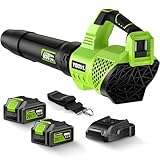
Ever wondered what makes that powerful gust of air? Whether it’s clearing leaves from your driveway, inflating an air mattress, or even cooling down a hot engine, blowers are indispensable tools in our lives. But how exactly do these machines generate such a forceful stream of air?
It’s a fascinating process rooted in simple physics, yet engineered with impressive precision. We’re going to break down the inner workings of a blower, from the most basic principles to the different types you’ll encounter. Get ready to understand the magic behind the breeze!
Understanding the Core Principle: Air Movement
At its heart, a blower works by moving air from one place to another, creating a directed flow. This might sound incredibly simple, but the way it achieves this movement is where the engineering brilliance lies. The fundamental concept is to create an area of higher pressure behind the air and an area of lower pressure in front of it, compelling the air to rush into the lower pressure zone.
Think of it like a wave. Something pushes the water at the back, and that push travels forward, creating movement. In a blower, it’s a mechanical component that provides this ‘push’ to the air.
Key Components of a Typical Blower
While blowers come in various shapes and sizes, most share a common set of essential components that work in harmony to produce airflow: (See Also: How Much To Replace A Blower Motor In A Car )
- Motor: This is the power source. It can be electric (AC or DC), gas-powered, or even powered by a vehicle’s engine. The motor’s job is to spin a rotor or impeller at high speeds.
- Impeller/Rotor: This is the moving part that directly interacts with the air. It typically consists of a series of blades or vanes attached to a central shaft. As the motor spins the shaft, the impeller rotates rapidly.
- Housing/Casing: This is the outer shell that encloses the impeller and directs the airflow. It’s designed to channel the air efficiently, preventing it from escaping and ensuring it’s expelled in the desired direction. The housing often has an inlet where air is drawn in and an outlet or nozzle where the pressurized air is discharged.
- Shaft: Connects the motor to the impeller, transmitting the rotational energy.
- Bearings: Support the shaft and allow it to rotate smoothly with minimal friction.
How Different Types of Blowers Work
The fundamental principle of moving air remains the same across different blower types, but the specific mechanism used to achieve this movement varies. Let’s explore some of the most common types:
1. Centrifugal Blowers
Centrifugal blowers, also known as radial blowers, are incredibly common and are used in everything from vacuum cleaners and leaf blowers to HVAC systems and industrial applications. They work by using centrifugal force to accelerate air outwards.
Mechanism:
- Air Intake: Air is drawn into the center of the impeller (the ‘eye’) through an inlet port in the housing.
- Impeller Rotation: The motor spins the impeller, which has a series of curved blades.
- Centrifugal Force: As the impeller rotates, the blades fling the air outwards towards the edge of the impeller. This outward motion is driven by centrifugal force.
- Pressure Build-up: As the air is thrown outwards, it gains kinetic energy. The housing is designed as a volute (a spiral shape). As the air is forced into this expanding volute, its velocity is converted into pressure. This creates a high-pressure zone around the impeller’s periphery.
- Air Discharge: The pressurized air is then directed out of the blower through an outlet port, creating a strong, steady stream.
Key Characteristics:
- High Pressure, Moderate Volume: They are excellent at generating significant pressure, making them suitable for applications requiring resistance to overcome, like pushing air through ducts.
- Versatile: Can handle both clean and dirty air, and even some particulate matter depending on the impeller design.
- Relatively Compact: Compared to some other types, they can be quite efficient in a smaller package.
Common Applications:
- Leaf blowers
- Vacuum cleaners
- Furnace and air conditioning systems (fans)
- Industrial drying and cooling
- Material handling
2. Axial Flow Blowers
Axial flow blowers, often referred to as fans, move air parallel to the axis of rotation of the impeller. Think of a typical desk fan or a propeller. They are designed to move large volumes of air at lower pressures.
Mechanism:
- Air Intake: Air enters the impeller from the front, moving along the axis of rotation.
- Impeller Rotation: The impeller has blades that are shaped like airfoils (similar to airplane wings). As the impeller rotates, these blades create a pressure difference across them.
- Lift and Thrust: The airfoil shape generates ‘lift,’ which, in this context, translates to a thrust that pushes the air forward, parallel to the shaft.
- Air Discharge: The air is pushed straight through the blower, exiting from the back in a directed flow.
Key Characteristics:
- High Volume, Low Pressure: Ideal for applications where moving a lot of air is more important than creating high pressure.
- Compact Design: Can be quite thin and designed to fit into tight spaces.
- Energy Efficient for Volume: Generally more energy-efficient for moving large quantities of air compared to centrifugal blowers.
Common Applications:
- Household fans (desk fans, ceiling fans)
- Computer cooling fans
- Ventilation systems
- Aircraft engines (turbofans)
- Marine propellers
3. Positive Displacement Blowers
Positive displacement blowers (PD blowers) are a bit different. Instead of continuously moving air, they trap a fixed volume of air and then force it out. They are known for their ability to deliver consistent airflow regardless of the discharge pressure. (See Also: How To Replace Blower Motor Resistor Connector )
Mechanism (roots Blower – a Common Type):
- Two Intermeshing Lobes: These blowers typically have two or more rotors with a specific lobe shape (often like figure-eights). These rotors are synchronized and rotate in opposite directions, driven by a common shaft and timing gears.
- Air Trapping: As the lobes rotate, they create expanding cavities on the inlet side. Air is drawn into these cavities.
- Air Displacement: The rotating lobes then seal off these cavities from the inlet. As the lobes continue to rotate, they move the trapped air towards the discharge side.
- Air Expulsion: At the discharge, the cavities shrink, forcing the trapped air out at a higher pressure. Crucially, there’s no compression happening within the blower itself; the pressure rise is due to the resistance at the outlet.
Key Characteristics:
- Constant Flow Rate: Deliver a predictable volume of air per revolution, regardless of system pressure.
- High Pressure Capability: Can achieve very high discharge pressures.
- Oil-Free Operation: Many designs are oil-free, making them suitable for applications where contamination is a concern.
- Pulsating Flow: The nature of trapping and releasing air can result in a slightly pulsating airflow, which might require dampeners.
Common Applications:
- Wastewater treatment (aeration)
- Pneumatic conveying of materials (cement, grain)
- Industrial vacuum systems
- Gas boosting
- Chemical processing
Factors Affecting Blower Performance
Several factors influence how well a blower performs its job:
| Factor | Impact on Performance | Explanation |
|---|---|---|
| Motor Power (HP/kW) | Directly influences the speed and torque available to drive the impeller. Higher power generally means more airflow or pressure. | A stronger motor can spin the impeller faster or overcome greater resistance. |
| Impeller Design (Blade Shape, Size, Number) | Affects how efficiently air is captured, accelerated, and directed. | Curved blades in centrifugal blowers are optimized for pressure, while airfoil shapes in axial fans are for volume. |
| Housing Design (Volute Shape, Inlet/Outlet Size) | Guides the airflow and converts velocity to pressure. | A well-designed housing minimizes turbulence and maximizes energy transfer. |
| Operating Speed (RPM) | Higher speeds generally lead to higher airflow and pressure. | The speed at which the impeller rotates is crucial. |
| System Resistance (Static Pressure) | The opposition to airflow caused by ductwork, filters, or other components. | High resistance can significantly reduce the actual airflow delivered by the blower. |
| Air Density and Temperature | Affects the mass of air moved and the energy required. | Colder, denser air provides more ‘stuff’ to move, but might require more power for the same volume. |
Maintenance and Longevity
To ensure your blower operates efficiently and lasts a long time, regular maintenance is key:
- Cleaning: Keep the inlet and impeller free of debris, dust, and obstructions. Clogged inlets restrict airflow and strain the motor.
- Lubrication: For blowers with greased bearings, follow the manufacturer’s recommendations for lubrication intervals and types.
- Inspection: Periodically check for loose parts, worn belts (if applicable), or unusual noises that could indicate a problem.
- Filter Replacement: If your blower uses an air filter, ensure it’s cleaned or replaced regularly to maintain optimal airflow and protect internal components.
Understanding these maintenance steps can prevent costly repairs and ensure your blower continues to perform as expected.
Beyond the Basics: Specialized Blowers
While centrifugal, axial, and positive displacement blowers cover the vast majority of applications, there are more specialized types, such as: (See Also: How To Start A John Deere Snow Blower )
- Regenerative Blowers (Side-Channel Blowers): These combine features of centrifugal and positive displacement blowers, offering high-pressure capabilities with a simpler design than PD blowers. They are often used for aeration and vacuum applications.
- Turbo Blowers: High-speed, high-efficiency centrifugal blowers that use advanced aerodynamics and variable speed drives for precise control and energy savings.
Each type has its unique strengths and is engineered for specific performance requirements. The choice of blower depends entirely on the application’s needs for airflow volume, pressure, efficiency, and operating environment.
Conclusion
So, how does a blower work? In essence, it’s all about harnessing mechanical energy to create a pressure differential that forces air to move. Whether it’s the outward fling of a centrifugal impeller, the airfoil lift of an axial fan, or the trapped volume of a positive displacement rotor, the goal is the same: to generate a directed flow of air.
Understanding these principles allows you to appreciate the engineering behind these common yet powerful devices and to choose the right one for your needs.