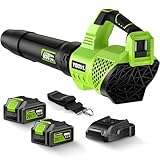
Ever wondered what makes that powerful gust of air happen? Whether it’s clearing leaves from your driveway, inflating an air mattress for guests, or even cooling down a hot engine, blowers are incredibly versatile tools.
But how do they actually achieve that impressive airflow? It’s a surprisingly elegant interplay of mechanics and physics. We’re going to break down the core principles behind how a blower works, demystifying the technology so you can appreciate these devices even more.
Get ready to understand the heart of your favorite air-moving machines!
The Fundamental Principles of Blower Operation
At its core, a blower is a device designed to move air. While the specific designs can vary wildly, from handheld leaf blowers to large industrial centrifugal fans, the fundamental principle remains the same: to create a pressure difference that forces air from one area to another.
Think of it like this: air naturally flows from an area of high pressure to an area of low pressure. A blower’s job is to artificially create this high-pressure area at its inlet and then direct that pressurized air out of its outlet.
Key Components of Most Blowers
While designs differ, most blowers share a few essential components:
- Motor: This is the power source. It’s typically an electric motor (AC or DC) or, in some cases, an internal combustion engine. The motor’s role is to provide the rotational energy needed to drive the fan or impeller.
- Fan/Impeller: This is the heart of the air-moving mechanism. It’s a rotating component with blades or vanes. As it spins, it imparts kinetic energy to the air, pushing it outwards and creating the desired airflow.
- Housing/Casing: This encloses the motor and fan/impeller, directing the airflow and ensuring that the air is channeled efficiently out of the blower’s nozzle or outlet. The shape of the housing is crucial for optimizing performance.
- Inlet: This is where the air enters the blower. It’s often designed to be as unobstructed as possible to allow for maximum air intake.
- Outlet/Nozzle: This is where the pressurized air is expelled. The shape and size of the outlet can significantly affect the speed and direction of the airflow.
Types of Blowers and Their Unique Mechanisms
The way a blower works can be broadly categorized into two main types, based on the design of their air-moving component: centrifugal blowers and axial blowers.
1. Centrifugal Blowers: The Workhorses
Centrifugal blowers, also known as radial blowers or fans, are perhaps the most common type. They work by drawing air into the center of a rotating impeller and then expelling it outwards radially, perpendicular to the axis of rotation. This outward motion is driven by centrifugal force. (See Also: How Much To Replace A Blower Motor In A Car )
How a Centrifugal Blower Works in Detail:
- Air Intake: Air enters the blower through the inlet, typically located at the center of the impeller (the ‘eye’ of the impeller).
- Impeller Rotation: The motor spins the impeller at high speeds. The impeller has a series of curved vanes or blades.
- Centrifugal Force: As the impeller rotates, the vanes catch the incoming air and accelerate it outwards. The centrifugal force generated by the spinning impeller throws the air away from the center and towards the outer edges of the impeller.
- Pressure Build-up: As the air is flung outwards, it gains both velocity and pressure. The air is forced into the blower’s housing, which is typically volute-shaped (like a snail shell).
- Volute Housing: The volute housing is designed to gradually increase in cross-sectional area as it moves away from the impeller. This design effectively converts the kinetic energy (velocity) of the air into potential energy (pressure). The slower-moving, higher-pressure air is then guided towards the outlet.
- Air Outlet: The pressurized air is discharged from the blower through the outlet or nozzle.
Key Characteristics of Centrifugal Blowers:
- High Pressure: They are excellent at generating high static pressures, making them suitable for applications where air needs to be pushed through resistance (e.g., ductwork, filters).
- Moderate Flow Rates: While they produce good pressure, their airflow volumes are typically moderate compared to axial blowers.
- Versatility: Found in a wide range of applications, including HVAC systems, industrial processes, vacuum cleaners, hair dryers, and leaf blowers.
Types of Centrifugal Impellers:
The design of the impeller vanes significantly impacts the performance characteristics of a centrifugal blower. Here are some common types:
| Impeller Type | Vane Shape | Characteristics | Typical Applications |
|---|---|---|---|
| Forward-Curved | Vanes curve in the direction of rotation. | Low noise, high flow rate at low speeds, compact size. Sensitive to system resistance. | Residential HVAC, comfort cooling. |
| Backward-Curved/Inclined | Vanes curve away from the direction of rotation. | High efficiency, stable performance over a wide range of pressures, self-limiting horsepower. | Industrial ventilation, high-pressure applications, clean air systems. |
| Radial | Straight vanes extending radially from the hub. | Robust, handles dusty or particulate-laden air well, high pressure capability. Lower efficiency than backward-curved. | Material handling, dust collection, high-temperature applications. |
| Airfoil | Vanes shaped like aircraft wings. | Very high efficiency, quiet operation, good for clean air. Less robust for dirty air. | Clean air ventilation, specialized industrial processes. |
2. Axial Blowers: The Volume Movers
Axial blowers, often called propeller fans, move air parallel to the axis of rotation. They work much like a screw propeller pushing through water, but in this case, they’re pushing air.
How an Axial Blower Works in Detail:
- Air Intake: Air is drawn into the fan from the front.
- Blade Rotation: The motor spins the fan blades. These blades are typically airfoil-shaped.
- Aerodynamic Lift: As the blades rotate, their airfoil shape creates a pressure difference between the front and back surfaces. This generates an aerodynamic lift force, which pulls the air along the axis of rotation.
- Airflow Generation: The rotating blades effectively ‘scoop’ and push the air forward, creating a stream of air that moves in the same direction as the fan’s axis.
- Outlet: The air is discharged from the back of the fan, moving in a relatively straight path.
Key Characteristics of Axial Blowers: (See Also: How To Replace Blower Motor Resistor Connector )
- High Flow Rates: They are designed to move large volumes of air.
- Low Pressure: They generate relatively low static pressures, making them less suitable for applications with significant resistance.
- Efficiency: Can be very efficient for their intended purpose of moving large volumes of air.
- Common Applications: Cooling fans in computers and electronics, ventilation fans in buildings, ship propellers, aircraft engines, and even some types of industrial exhaust systems.
Types of Axial Fan Designs:
- Propeller Fans: Simple design, usually with 2-6 blades, for high volume, low-pressure applications.
- Vane-Axial Fans: These have a set of guide vanes before or after the impeller to straighten the airflow and improve efficiency and pressure.
- Tube-Axial Fans: Similar to vane-axial but typically mounted in a cylindrical housing.
Beyond the Basics: Specialized Blower Technologies
While centrifugal and axial designs form the bedrock of blower technology, there are specialized types that employ unique mechanisms to achieve specific results.
1. Positive Displacement Blowers (pd Blowers)
Unlike centrifugal and axial blowers that rely on creating a pressure difference with rotating impellers, positive displacement blowers trap a fixed volume of air and physically move it from the inlet to the outlet.
How PD Blowers Work:
- Trapping Air: These blowers typically use two or more meshing lobes or rotors that rotate within a housing. As the lobes rotate, they create expanding cavities on the inlet side, which draw in air.
- Moving Air: The meshing lobes then rotate, sealing off these cavities and physically pushing the trapped air towards the outlet.
- Discharge: At the outlet, the cavities shrink, forcing the air out at a higher pressure.
Key Characteristics of PD Blowers:
- Constant Flow Rate: They deliver a nearly constant volume of air regardless of the system’s back pressure.
- High Pressure: Capable of generating very high pressures.
- Applications: Used in applications requiring precise air delivery, such as pneumatic conveying of materials, wastewater treatment (aeration), and industrial processes where constant pressure is critical.
Common examples include Roots blowers (with figure-eight shaped rotors) and screw blowers.
2. Regenerative Blowers (side-Channel Blowers)
These are a hybrid type that combines elements of both centrifugal and positive displacement principles, though they are often classified as centrifugal. (See Also: How To Start A John Deere Snow Blower )
How Regenerative Blowers Work:
- Impeller and Housing: They feature an impeller with blades that run parallel to the shaft. The impeller spins within a housing that has a channel along its side.
- Recirculating Air: As the impeller rotates, it pushes air into the side channel. The air then recirculates multiple times within this channel, gaining energy with each pass.
- Pressure Build-up: With each ‘regeneration’ or pass through the channel, the air’s pressure increases incrementally.
Key Characteristics of Regenerative Blowers:
- High Pressure and Moderate Flow: They offer a good balance of pressure and flow, often higher pressure than standard centrifugal fans but lower flow than axial fans.
- Compact Size: Generally very compact for their performance.
- Applications: Widely used in vacuum packaging, medical equipment, aeration in aquariums, and small-scale industrial applications.
Factors Influencing Blower Performance
Several factors come into play when determining how effectively a blower operates:
- Motor Power: A more powerful motor can drive the impeller at higher speeds or handle larger impellers, leading to greater airflow and pressure.
- Impeller/Fan Design: As discussed, the shape, size, and number of blades or vanes are critical.
- Housing Design: The shape and dimensions of the housing are engineered to efficiently channel and convert air velocity into pressure.
- System Resistance: This is the opposition to airflow caused by ductwork, filters, dampers, or the application itself. Higher system resistance requires a blower capable of generating more pressure.
- Air Density: Denser air (e.g., at lower temperatures or higher altitudes) will affect performance.
- Maintenance: Clogged inlets, dirty fan blades, or worn bearings can significantly reduce a blower’s efficiency and output.
Common Blower Applications in Everyday Life
Understanding how blowers work allows us to appreciate their ubiquitous presence:
- Leaf Blowers: These are typically powerful centrifugal blowers designed to generate a high-velocity stream of air to clear debris.
- Hair Dryers: Contain a small motor and fan (often centrifugal) to push heated air over your hair.
- Vacuum Cleaners: Use a powerful motor and fan to create a strong suction (low pressure) to draw in dirt and debris.
- HVAC Systems: Central heating, ventilation, and air conditioning systems rely on centrifugal blowers to circulate conditioned air throughout a building.
- Inflatable Structures: Continuous blowers are used to maintain the inflation of bounce houses and other inflatable attractions.
- Computer Cooling: Small axial fans are essential for dissipating heat from computer components.
Each application leverages the specific strengths of different blower types to achieve its intended function. Whether it’s the high pressure of a leaf blower or the high volume of a computer fan, the fundamental principles of air movement are at play.
Conclusion
So, how does a blower work? It’s all about creating a pressure difference. Whether it’s the outward fling of a centrifugal impeller, the aerodynamic push of an axial fan, or the physical trapping of air in a positive displacement unit, the goal is the same: to move air efficiently.
By understanding the interplay of motors, impellers, and housing design, you can better appreciate the engineering behind these essential devices that power everything from your hairdryer to industrial machinery.